Australia's inter-election period + Mexico's judges + Samoa votes
The period after an election is always a funny little time. The winners are getting on with it, the losers are licking their wounds and lashing out at each other, and the world is moving on, even as the final figures and seats continue to dribble in. Folks, the election ain't over yet! On the personal front, I have at least had some days off and returned to relatively normal sleeping hours, so that's something.
While we wait for some of those final results and commence the inter-election period, I'm starting to get underway on some other reporting projects and planning for future elections. That sees me reading a lot and trying out a lot of new things, many of which never actually make it into an ABC news story. I thought I'd share some of that here. It'll be rough, unpolished, and I'm not committing to publishing regularly. Sometimes I might share some draft graphics, sometimes some extra details on a story I've written, sometimes a roundup of links and news stories. A lot of it will be about elections, but not always.
Basically, I'm opening up my notebook to you, to make myself accountable for properly documenting what I'm looking at and reading. I’m hoping it will help me keep track of what I should be paying attention to, and if it’s interesting to you, well so be it.
Here’s something I’ve been playing with this week: sankey flow charts to represent election results. This one shows how lower house seats in parliament have changed hands from election to election. For now I have assumed the Liberals retain Bradfield as they currently lead there, but given the margin this is far from certain.
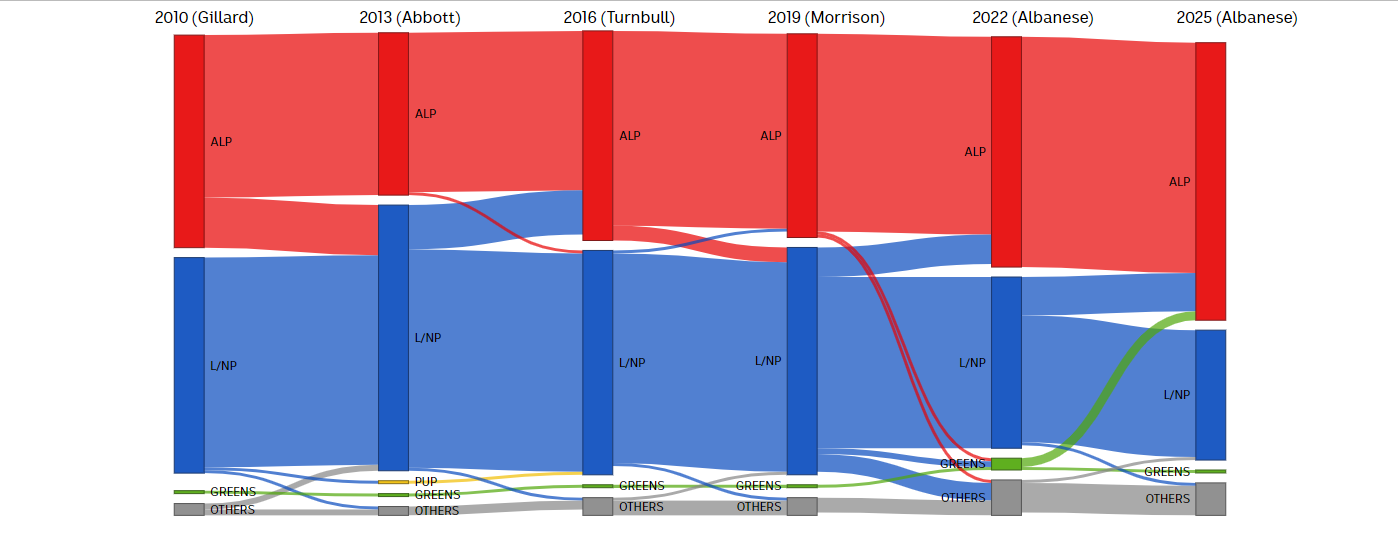
We all know Labor have a lot more seats than the Coalition, but seeing the party rooms now compared to the previous five elections really clearly demonstrate that how few conservatives there are now.
There's nothing revelatory in this, but I do like how it shows the ebbs and flows from election to election, and the size of the double-defeat for the Coalition over the past two elections that they now need to reverse to make it back into (majority) government.
In other election news…
Bradfield remains, uh, close
Scrutineers in the Sydney seat of Bradfield are probably starting to go cross-eyed, four days into a recount in the seat where independent Nicolette Boele is trying to wrest the seat from Liberal hands. When the count was complete last Friday, Liberal Gisele Kapterian was ahead of Boele by just eight votes.
The electoral commission automatically recount seats where the margin is less than 100 votes, and eight is famously less than 100, so it was back to the start for counting staff on Monday.
After three days of recounting, some small adjustments have been made, and Kapterian now leads Boele by…. two votes.
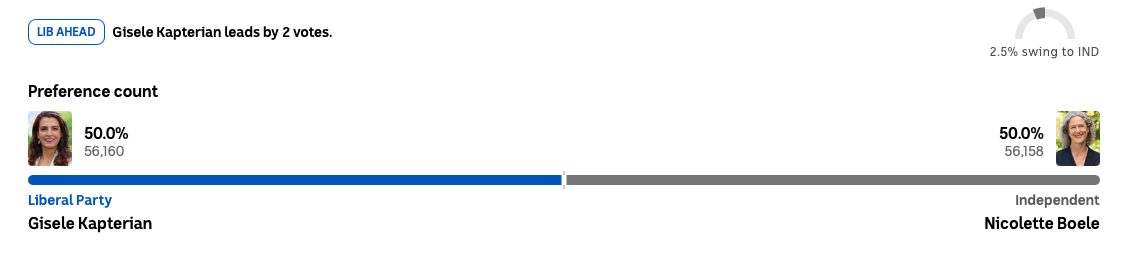
There are very few ways (precisely two of them, in fact) that this could be closer.
Meanwhile in The Other Place
Meanwhile, the AEC is making good progress finalising Senate counts. It takes a lot longer to process the upper house ballot tablecloths, but the good thing is they get data entered into the AEC computer system so the distribution of preferences can be calculated very quickly once that data entry is done.
The so-called “button press” has now happened in Tasmania, Victoria, SA and both territories. It’s confirmed that Labor have gained a senate seat from the Liberals in both Victoria and South Australia, and that Jacqui Lambie has retained her seat in Tasmania.
We’ll know the winners of Western Australia and Queensland’s seats this afternoon, and NSW will be finalised tomorrow morning.
Do corflutes serve as guerilla marketing for elections?
Large corrugated plastic posters will no longer blight the beautiful Stobie poles of South Australia, after the state’s parliament banned election corflutes last year.
The bill had bipartisan support on environmental and aesthetic grounds. Members of the youth wings of political parties probably also rejoiced they’ll no longer be forced to drive a ute around the mean streets of Adelaide with a step ladder and cable ties in the wee hours after an election is called, fighting off other parties for the best spots.
But now the ABC reports the state’s electoral commission is worried the lack of corflutes could make people less aware an election is actually happening, calling it one of the "challenges" it’s facing ahead of the next state election in March. It says a survey held after the Dunstan by-election "revealed that the recent ban on corflutes significantly impacted electors' awareness".
The lack of corflutes didn’t seem to affect turnout in the federal election, but you do have to admit there’s less of an election vibe in the air when you’re not being constantly gazed upon by smiling politicians every time you leave the house to pick up some Fruchocs and Farmers Union Iced Coffee from On The Run.
Mexico’s big bold judicial election
A small handful of countries put some judicial positions up for public election, but none have tried what Mexico is about to do: ask voters to choose every single judge, in every single court. On June 1, Mexicans will elect thousands of judges across the country, including Supreme Court justices. In 2027, they’ll finish the job, electing judges to all remaining positions.
It is an… interesting experiment.
The Economist reports that to get on the ballot, a candidates needs to have “a law degree with good grades, five years of legal experience and five letters of recommendation”.
This new judicial electoral system was one of the last laws former President Andres Manuel Lopez Obrador signed. He said it would stamp out corruption in the judiciary, but many observers have argued that putting judges up for election is the kind of thing that could do, well, the opposite.
Mexico sees political violence step up in the lead-up to elections, and it’s not hard to see why criminal gangs would be interested in who presides over the courts.
While a lot of people overseas are looking on a little puzzled, judicial elections are popular in Mexico, at least for now: Pew Research found two thirds of Mexican adults broadly approve of the new law.
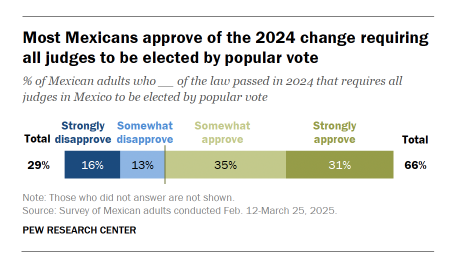
Having said that, turnout this weekend is expected to be quite low.
Samoa heads to the polls
Samoa’s government has fallen and there’ll be a snap general election in the next few months, after Prime Minister Fiame Naomi Mata’afa’s budget bill was defeated 34 votes to 16 this week. Parliament has now been dissolved far earlier than planned: the next election wasn’t due to be held until next year.
Samoa’s electoral commission had already started a voter registration drive for the 2026 elections, and it will need to be drastically sped up, as according to The Samoa Observer, only around half of the expected electoral roll are currently registered to vote.
The snap election has tested Samoa’s electoral laws too: the electoral commission is reportedly working with the (now caretaker) Attorney-General to get a court to change the roll close and nomination deadlines, which are currently required six months before a general election.
Fiame is Samoa’s first female Prime Minister, and before that was the first female cabinet minister and deputy PM. She won power from the country’s longest serving leader Tuilaepa Sailele Malielegaoi after an election and a constitutional crisis in 2021. Malielegaoi is currently the opposition leader.
The Prime Minister has been battling to hold on to power since January, when she sacked her party’s chairman, who is facing criminal charges, from her ministry. Members of her own party had been trying to remove her, and in March one of her former associate ministers said in parliament that “your leadership would have been remarkable if you had gotten married and someone would advise you”.
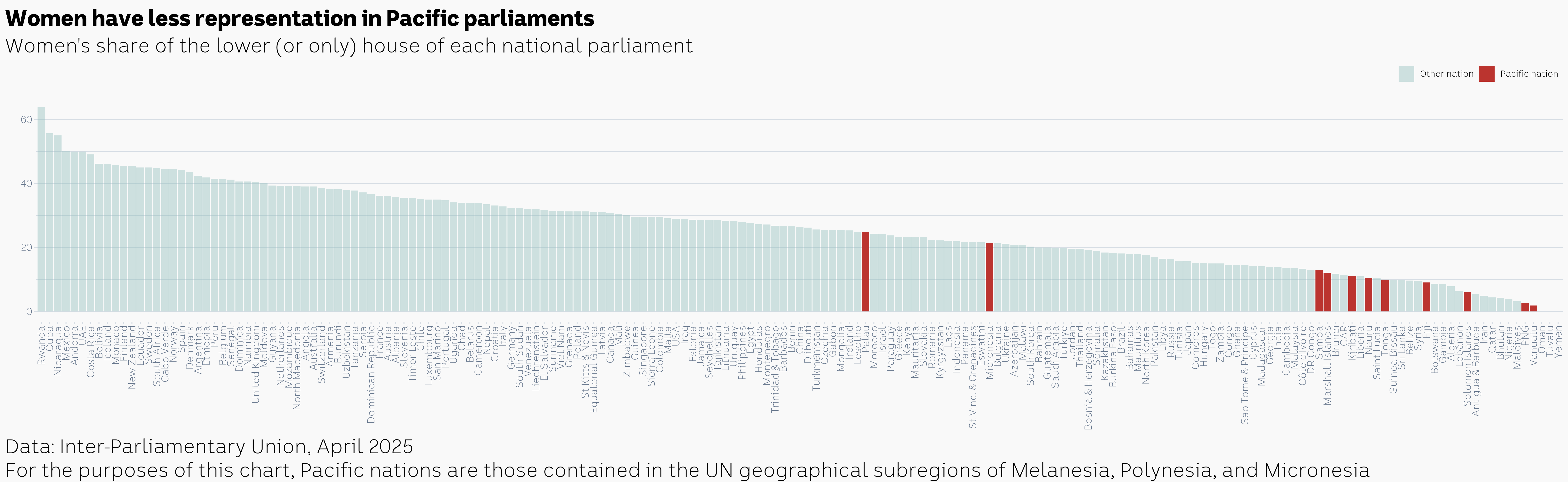
She’s one of only two female leaders in the Pacific, and women make up just 13 per cent of Samoa’s parliament, according to data compiled by the Inter-Parliament Union. As you can see in the chart below, that’s on the low end of global parliaments, but it’s still higher than the parliamentary representation of women in Kiribati (11.1 per cent), Nauru (10.5 per cent), and Solomon Islands (6 per cent)
Coming up
- June 1: Poland Presidential election (round 2)
- June 3: South Korea Presidential election (two years early due to the impeachment of Yoon Suk Yeol)
- June 5: Burundi National Assembly election
- June 8: Italy referendum with five questions, including one to halve the time non-EU foreigners need to live in Italy before applying for citizenship to five years.
No spam, no sharing to third party. Only you and me.
Member discussion